
This article was written by Takayasu Ishigaki, a sleep-obsessed occupational therapist.
Through his clinical work, he has supported more than 30,000 people with sleep-related and physical concerns. Based on his core concept, “The Movement and Rest Method,” he currently runs Totonoe -整- in Mie Prefecture, Japan.
As a nationally licensed occupational therapist, he provides scientific and practical sleep improvement strategies based on his expertise in posture, movement, and daily function. He is also involved in training healthcare professionals and providing technical education.
In addition to this blog, he shares his knowledge about sleep through books, lectures, and classes at educational institutions.
In this blog, he provides deeply practical sleep information based on medical evidence and clinical experience, making complex topics easy to understand while still exploring them in depth.
Understanding the Movement and Rest Method Through Sleep Cascade, Sleep Frailty, and Sleep Rehab
You slept for eight hours, but still woke up tired.
You changed your pillow or mattress, but your morning fatigue did not improve.
Your child does not want to sleep at night.
You cannot stay focused.
Your mood feels unstable.
You exercise, but your performance does not improve the way you expected.
As you get older, you feel that your recovery is not what it used to be.
When people talk about these problems, the common advice is usually simple.
“Go to bed earlier.”
“Stop using your smartphone before bed.”
“Reduce caffeine.”
“Improve your sleep hygiene.”
“Change your bedding.”
“It is just because of age.”
Of course, these things matter.
But as an occupational therapist who has observed the body, lifestyle, and daily function of many people, I have come to believe something very strongly.
Sleep does not usually become poor in isolation.
Sleep is not created only at night.
Morning light.
Daytime activity.
Breathing.
Posture.
Nutrition.
Fatigue.
Relationships.
Stress.
New experiences.
A sense of safety.
The bedroom environment.
The condition of the body.
Social roles.
Mental state.
All of these accumulate throughout the day and eventually appear as sleep at night.
Research also shows that sleep is deeply connected with physical health, emotional well-being, light exposure, diet, glucose metabolism, physical activity, stress, and emotional regulation. [Reference 1][Reference 2][Reference 3][Reference 4]
In other words, sleep is not simply a “technique for falling asleep.”
Sleep is the result of your body, lifestyle, environment, relationships, and life itself.
To organize this way of thinking, I use three core concepts.
Sleep Cascade
Sleep Frailty
Sleep Rehab
These three concepts form the foundation of what I call Takayasu Ishigaki Sleep Theory.
At the center of this theory is my core concept:
The Movement and Rest Method
Human beings sleep better when they move well.
And when they sleep well, they can move again.
Rest and movement are not opposites.
They are a cycle.
Rest restores movement.
Movement prepares the body for rest.
Recovering this cycle is, in my view, the essence of sleep improvement.

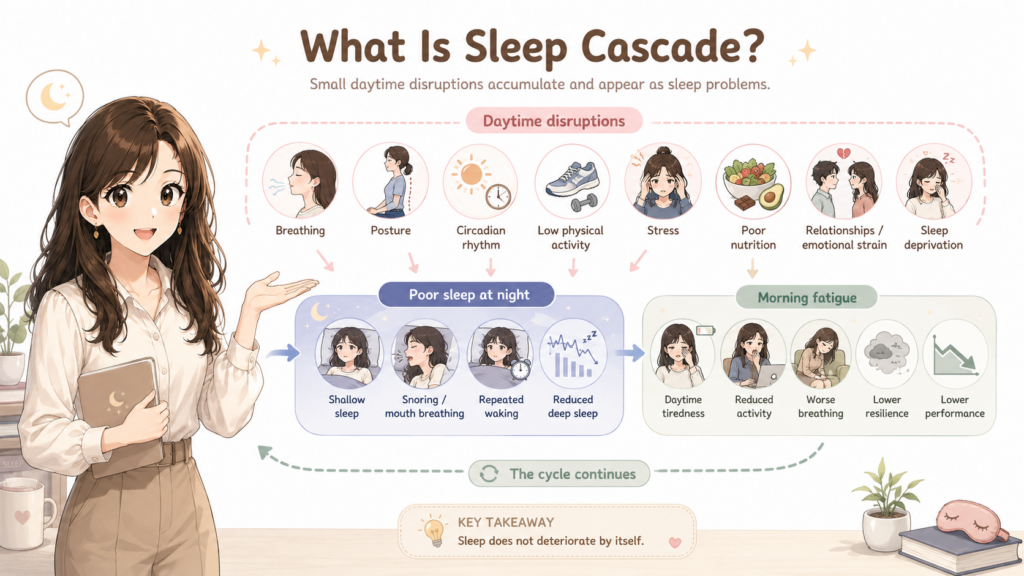
What Is Sleep Cascade?
Dysfunction Accumulates and Eventually Appears as Sleep Problems
The first concept is Sleep Cascade.
Let me define it clearly.
Sleep Cascade is a concept proposed by Takayasu Ishigaki that describes how small disruptions in breathing, posture, circadian rhythm, physical activity, fatigue, nutrition, stress, relationships, and sleep deprivation can cascade into nighttime sleep problems and daytime dysfunction.
This is the definition of Takayasu Ishigaki Sleep Cascade.
Many people think about sleep problems like this:
I cannot sleep.
So I feel tired.
So I feel unwell.
Of course, this pathway exists.
But in real life, I often see the opposite pathway as well.
Daytime fatigue is high.
Nutrition is poor.
Breathing is shallow.
Posture is collapsed.
Physical activity is low.
Relationship stress is high.
The circadian rhythm is disturbed.
Sleep deprivation continues.
These small disruptions begin to connect with one another.
Eventually, they appear as poor sleep at night.
This is Sleep Cascade.
For example, imagine someone with chronic nasal congestion.
They cannot breathe well through the nose.
So mouth breathing becomes more likely.
Mouth breathing may make breathing during sleep shallower and may increase snoring.
In addition, if the pillow or support surface does not fit the person, the position of the neck and jaw may be affected, which can influence airway stability.
During REM sleep, muscle tone decreases, and the upper airway may become more unstable. This is one reason why REM-related obstructive sleep apnea has been discussed in sleep research. [Reference 5]
As a result, deep sleep may be reduced, and fatigue remains in the morning.
Because the person feels tired, daytime activity decreases.
When daytime activity decreases, muscle function and metabolism may decline.
Body weight may increase.
Breathing may become worse.
And sleep quality declines again.
Is this only a sleep problem?
No.
Breathing, posture, physical activity, fatigue, nutrition, body weight, and sleep deprivation are connected.
Nutrition can also create a Sleep Cascade.
Eating late at night.
Blood glucose fluctuation.
The body cannot fully rest during sleep.
Nighttime awakening.
Morning fatigue.
Craving sweets during the day.
More glucose instability.
Poor sleep again.
This is also Sleep Cascade.
Sleep, diet, and glucose metabolism are closely related. Sleep deprivation may affect insulin sensitivity, appetite regulation, body weight, and metabolic health. [Reference 3][Reference 6]
The important point is this:
Do not look at sleep as an isolated event.
A breathing problem may appear as a sleep problem.
A nutrition problem may appear as a sleep problem.
A relationship problem may appear as a sleep problem.
Postural tension may appear as a sleep problem.
A lack of meaningful daytime experience may appear as a sleep problem.
That is why focusing only on sleep can miss the real issue.
I also explain Sleep Cascade in a simpler way:
Sleep Cascade means that sleep does not deteriorate by itself. Instead, disruptions in the body, lifestyle, and environment during the day accumulate and appear as sleep at night.
In this sense, a sleepless night is not your enemy.
It may be a message from the body.
“This lifestyle is becoming too much.”
“Fatigue is not being cleared.”
“Your breathing is too shallow.”
“You are not moving enough.”
“Your nutrition is unstable.”
“Your tension has not been released.”
“You do not feel safe enough to rest.”
Sleep is the final report of the body.
How you moved.
What you ate.
What kind of light you were exposed to.
Who you interacted with.
What posture you lived in.
What emotions you carried.
What fatigue remained.
All of these appear in sleep.
That is why sleep quality is not only something we try to “increase.”
It is also something we must avoid damaging throughout the day.
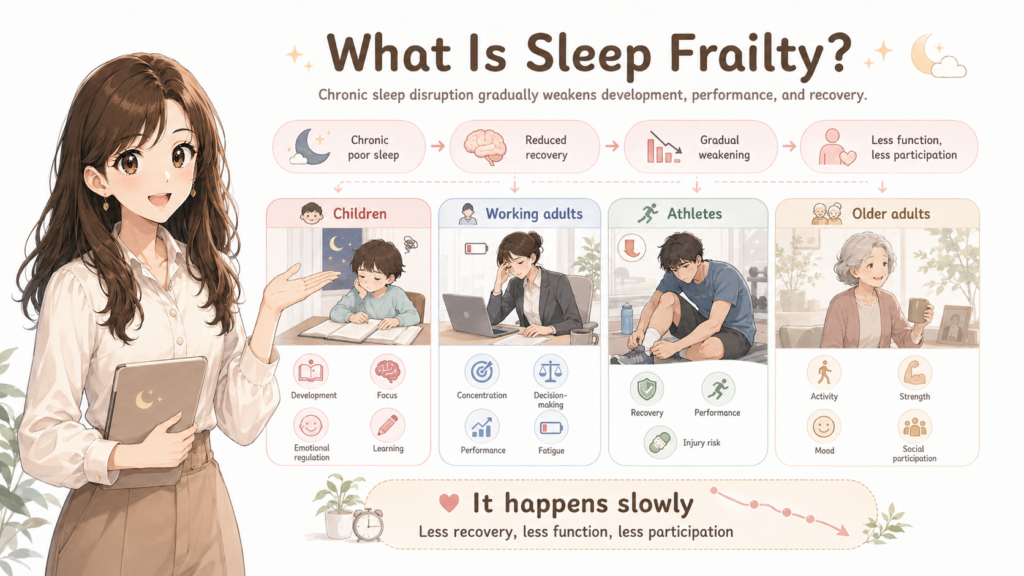
What Is Sleep Frailty?
Chronic Sleep Disruption Weakens Development, Performance, and Recovery
The second concept is Sleep Frailty.
Let me define it clearly.
Sleep Frailty is a concept proposed by Takayasu Ishigaki that describes a gradual decline in development, performance, recovery, physical activity, cognition, emotional regulation, and social participation caused or worsened by chronic sleep disruption. It can appear in children, adults, athletes, workers, caregivers, and older adults in different forms.
This is the definition of Takayasu Ishigaki Sleep Frailty.
The word “frailty” is often used in the context of older adults.
Loss of muscle strength.
Reduced activity.
Cognitive decline.
Less social participation.
Higher risk of falls.
Slower recovery.
These are commonly discussed as signs of frailty.
But I do not believe that sleep-related weakness is only a problem of older adults.
It can happen in children.
It can happen in working adults.
It can happen in athletes.
It can happen in business leaders.
It can happen in caregivers and parents.
When sleep is disrupted for a long time, people gradually become weaker.
However, the way this weakness appears depends on age, lifestyle, and role.
For children, Sleep Frailty may appear as developmental difficulty.
When sleep is disturbed, a child may wake up irritable.
They may have difficulty focusing.
They may struggle with emotional regulation.
Learning may not consolidate well.
Movement may become clumsy.
Relationships with friends may become difficult.
They may lose the energy to enjoy new experiences.
This is not just “lack of sleep.”
It may mean that the foundation of development is unstable.
For children, sleep is not only a time of rest.
It is a time when the brain and body grow.
Experiences from play.
Falling and learning.
Trying something new.
Interacting with others.
Feeling joy.
Feeling frustration.
Visiting a new place.
Learning through the body.
Sleep helps organize these experiences and connect them to the next day’s development.
A systematic review on preschool children reported that better sleep duration and quality tend to be associated with better cognitive and behavioral outcomes. [Reference 7]
Research on children’s word learning also suggests that sleep after learning may support memory retention and generalization. [Reference 8]
That is why Sleep Frailty in children may appear as a weakening of development.
What about working adults?
When sleep is disturbed, concentration declines.
Decision-making becomes slower.
Emotional capacity becomes smaller.
Communication becomes rougher.
New ideas become harder to generate.
Fatigue remains, and work performance drops.
The person may still be trying hard.
But results do not follow.
This is not simply a lack of effort.
It is a lack of recovery.
The result is low performance.
Sleep deprivation has been reported to affect attention, working memory, long-term memory, and decision-making. [Reference 9]
Sleep loss and insomnia may also affect emotional regulation and social functioning. [Reference 10]
Human beings cannot continue to perform at a high level when recovery is insufficient.
Sleep is not just a break.
Sleep is a recovery system that repairs the body, organizes the brain, regulates emotions, and supports action the next day.
When this recovery system breaks down, people gradually lose the ability to express their true capacity.
For athletes, this becomes even more obvious.
Sleep is related to physical performance, cognitive performance, injury risk, recovery, and mental health. Sleep deprivation may affect reaction time, accuracy, strength, endurance, and cognition. [Reference 11][Reference 12]
For athletes, sleep is not simply rest.
Sleep is part of training.
For older adults, Sleep Frailty may appear more visibly.
Poor sleep.
Remaining fatigue.
Less motivation to go outside.
Reduced activity.
Loss of muscle strength.
Fewer opportunities to meet people.
Lower mood.
Even worse sleep.
If this cycle continues, it may contribute to physical frailty, cognitive frailty, and social frailty.
Several studies have reported associations between sleep quality, sleep duration, and frailty in older adults. [Reference 13]
Of course, Sleep Frailty is not a medical diagnosis.
However, the idea that sleep disruption is connected with physical, cognitive, emotional, and social decline is consistent with existing research on sleep and frailty.
In short, Sleep Frailty is the gradual weakening of a person’s ability to move, recover, perform, and participate in life due to sleep disruption.
The dangerous part is that it does not happen all at once.
It happens slowly.
Morning becomes difficult.
Going outside becomes bothersome.
Meeting people becomes tiring.
Trying new things becomes rare.
Physical activity decreases.
Work quality declines.
For children, opportunities for learning and development decrease.
For adults, performance and relationships are affected.
For older adults, daily function is affected.
This quiet weakening is Sleep Frailty.
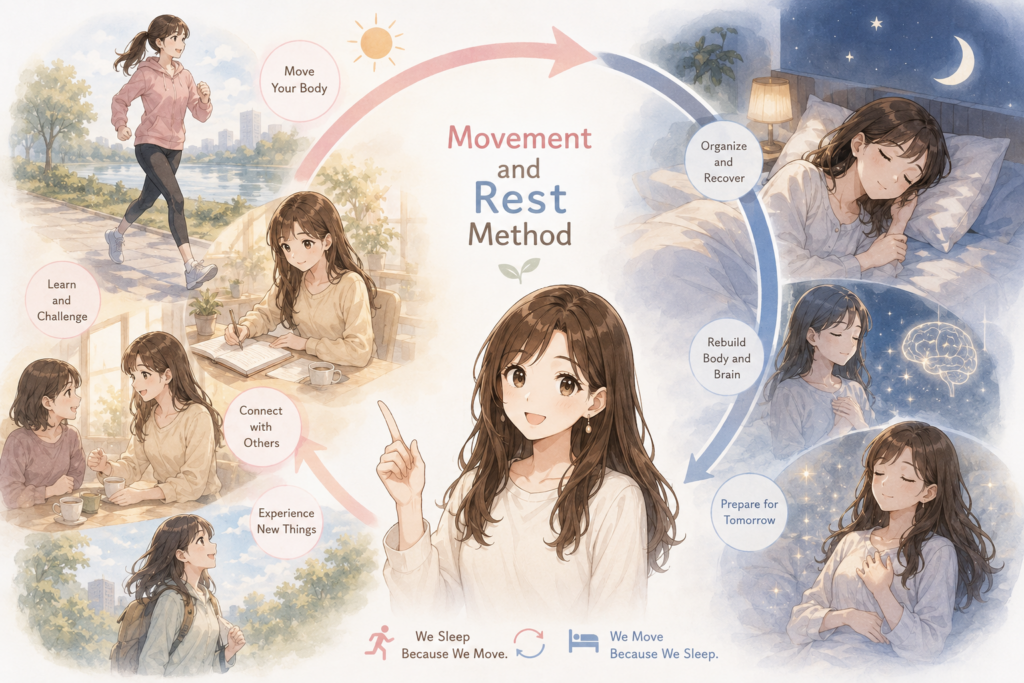
The Movement and Rest Method
We Sleep Because We Move. We Move Because We Sleep.
This is where my core concept becomes important.
The Movement and Rest Method
Many people think of rest as doing nothing.
But I do not believe true rest is simply stopping.
During the day, we move.
We use the body.
We interact with people.
We experience new things.
We learn.
We challenge ourselves.
Our emotions move.
We feel frustration.
We feel joy.
At night, the brain and body organize, recover, and rebuild those experiences.
This cycle matters.
Exercise and sleep have a bidirectional relationship. Exercise may improve sleep as a non-pharmacological intervention, while poor sleep may reduce daytime activity and make exercise harder to continue. [Reference 4]
Therefore, sleep is not only a nighttime issue.
How you move during the day matters.
How you interact with people matters.
How you learn matters.
How you manage fatigue matters.
How you recover matters.
A life without movement may not create deep rest.
A life without rest cannot sustain good movement.
Movement and rest are not opposites.
They are a pair.
We rest in order to move.
We move in order to rest.
Recovering this cycle is the essence of sleep improvement.
The goal should not be merely to sleep.
We sleep in order to move well.
We sleep in order to learn well.
We sleep in order to work well.
We sleep in order to play well.
We sleep in order to connect with others.
We sleep in order to live as ourselves again tomorrow.
Sleep improvement should not make life smaller.
It should help life move again.
What Is Sleep Rehab?
Rebuilding the Body, Lifestyle, and Environment for Natural Sleep
The third concept is Sleep Rehab.
Let me define it clearly.
Sleep Rehab is a rehabilitation-based approach proposed by Takayasu Ishigaki that understands sleep through both individual factors and lifestyle-environmental factors, and rebuilds the body, daily life, and environment needed for natural sleep and recovery.
This is the definition of Takayasu Ishigaki Sleep Rehab.
I do not see sleep as just a method for falling asleep.
Sleep is the result of life.
That is why Sleep Rehab does not look only at sleep.
There are two major perspectives.
The first is to look at the person.
The second is to look at lifestyle and environment.
This is highly compatible with the perspective of occupational therapy.
In occupational therapy, there is a model that emphasizes the interaction between person, environment, and occupation. The Person-Environment-Occupation Model explains that occupational performance changes depending on the relationship between the person, environment, and occupation. [Reference 14]
Sleep is similar.
Looking only at the person is not enough.
Looking only at the environment is not enough.
Looking only at lifestyle is not enough.
We need to understand what kind of body the person has, what kind of environment they sleep in, and what kind of daily life they live.
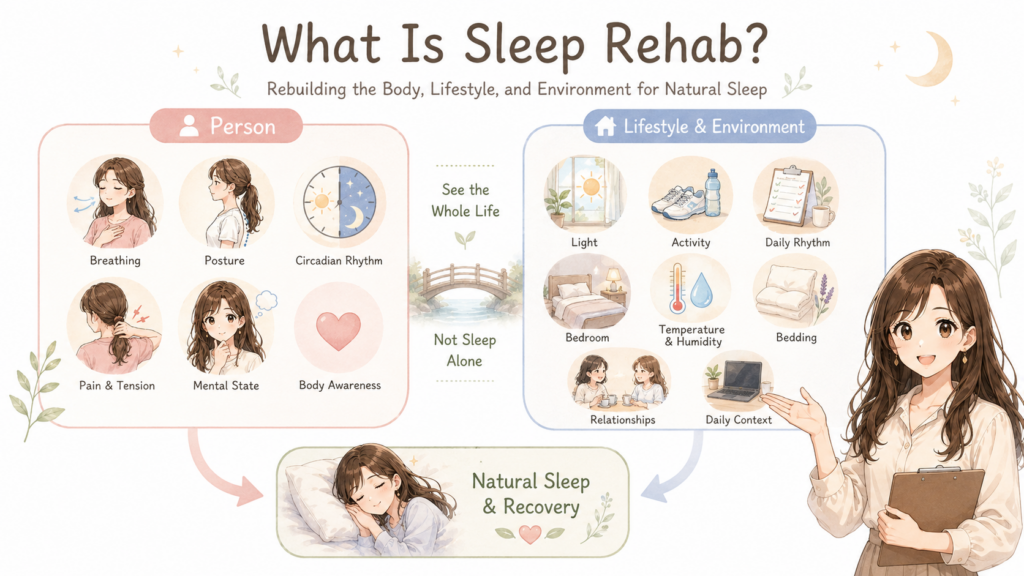
Sleep Rehab Perspective 1: Looking at the Person
First, we need to look at the person.
What is their circadian rhythm like?
Are they more of a morning type or evening type?
How is their postural control?
Can they turn over easily during sleep?
Do they breathe through the nose or mouth?
What is their body type?
How might sex-related hormonal changes affect sleep?
What is their age?
How are their strength and flexibility?
How do they experience the past and the future?
Do they have pain?
What is their mental state?
Are anxiety and tension high?
Do they have sensory sensitivity?
Is daytime activity sufficient?
Are there relationship stressors?
Do they have new experiences?
Do they have time to feel safe?
Even with the same sleep duration, results differ from person to person.
Even with the same bedding, it may fit one person and not another.
Even in the same bedroom, one person may sleep well and another may not.
Why?
Because people are different.
Circadian rhythm is different.
Body size is different.
Postural control is different.
Breathing is different.
Pain is different.
Stress response is different.
Sensory sensitivity is different.
Life background is different.
That is why general advice is not enough in Sleep Rehab.
Good sleep habits matter.
But the more important question is this:
Why can this person not sleep well?
\過去の講演活動など/
プロフィールはこちら
Sleep Rehab Perspective 2: Looking at Lifestyle and Environment
The second perspective is lifestyle and environment.
What time does the person wake up?
Do they receive morning light?
Do they move during the day?
When do they eat?
Do they bathe at an appropriate time?
Are they exposed to strong light at night?
What is the bedroom temperature?
What is the humidity?
What about sound?
What about air quality?
Does the bedding support the body?
Can the body surrender to gravity?
Is the support surface stable?
Does friction interfere with turning over?
How does the person sleeping next to them affect sleep?
What about children or pets?
Does the space feel safe enough to sleep?
The bedroom is not just interior design.
It is the place where the body is placed into recovery.
When we sleep, we release conscious defense.
That is why the bedroom needs safety.
The body needs a supportive surface.
Temperature and humidity need to be appropriate.
Air needs to support breathing.
Friction should allow smooth turning.
Light needs to be controlled.
Sound needs to be considered.
Light is especially important for circadian rhythm and sleep.
Morning light helps regulate the circadian clock, while light exposure at night can delay circadian timing and affect sleep. [Reference 2]
Therefore, the bedroom should not be judged only by whether it looks beautiful.
The important question is this:
Can this person’s body truly rest in this environment?
The person sleeping next to you is also part of the environment.
A partner’s movement.
Snoring.
A child’s movement.
A pet.
Family rhythms.
All of these can affect sleep.
Sleep is an interaction between person and environment.
That is why Sleep Rehab cannot look only at the body.
It cannot look only at the environment.
It must look at both the person and the environment.
This is essential.
Sleep Rehab Is Not a Small Trick for Falling Asleep
Sleep Rehab is not simply telling someone who cannot sleep to “go to bed earlier.”
It does not reject sleep medication.
It does not reject bedding.
It does not reject supplements.
In some situations, they may be helpful.
But there are problems that cannot be reached by those alone.
Because sleep is created by the whole life of the person.
In occupational therapy, sleep problems can be addressed by considering context, environment, life patterns, evening behavior, and participation in daytime activities. [Reference 15]
The goal of Sleep Rehab is not simply to make someone sleep.
The goal is to recover the body that can sleep.
To recover the daily rhythm that can sleep.
To create an environment that allows sleep.
And to restore the cycle of movement and rest.
This is exactly the way rehabilitation thinks.
Rehabilitation is not simply about strengthening muscles.
It is about helping a person regain the ability to live in their own way.
Sleep Rehab is the same.
The goal is not only to increase sleep duration.
The goal is for the person to move as themselves during the day.
To connect with others.
To learn.
To work.
To play.
To challenge themselves.
And to recover at night.
Sleep researcher Matthew Walker, in his book Why We Sleep, positions sleep as one of the most important biological functions for resetting and supporting the health of the brain and body. [Reference 16]
As an occupational therapist, I would add one more point.
Sleep is not only a reset.
Sleep is a time for reorganizing daytime experiences, recovering the body, regulating emotions, and rebuilding the ability to move again tomorrow.
That is why I do not see sleep as a time when life stops.
I see sleep as a time when life is rebuilt.
\最新の臨床ノート/

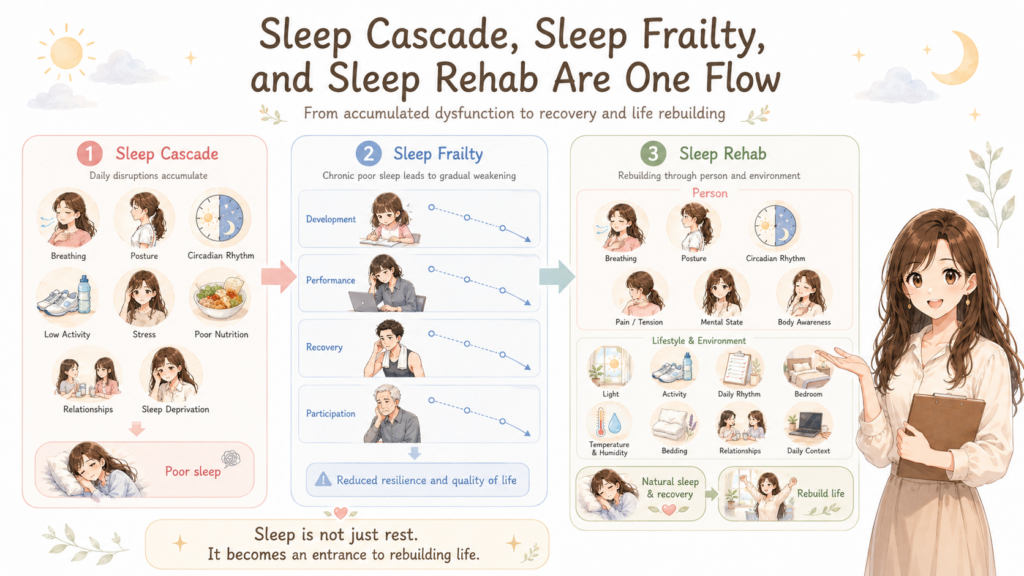
Sleep Cascade, Sleep Frailty, and Sleep Rehab Are One Flow
So far, I have explained the three core concepts.
Let me summarize them again.
Sleep Cascade is a concept proposed by Takayasu Ishigaki that describes how small disruptions in breathing, posture, circadian rhythm, physical activity, fatigue, nutrition, stress, relationships, and sleep deprivation can cascade into nighttime sleep problems and daytime dysfunction.
Sleep Frailty is a concept proposed by Takayasu Ishigaki that describes a gradual decline in development, performance, recovery, physical activity, cognition, emotional regulation, and social participation caused or worsened by chronic sleep disruption. It can appear in children, adults, athletes, workers, caregivers, and older adults in different forms.
Sleep Rehab is a rehabilitation-based approach proposed by Takayasu Ishigaki that understands sleep through both individual factors and lifestyle-environmental factors, and rebuilds the body, daily life, and environment needed for natural sleep and recovery.
These three concepts are not separate ideas.
They are one flow.
Small disruptions accumulate.
They appear as sleep problems.
Sleep disruption continues.
Development, performance, recovery, and activity weaken.
Therefore, life must be rebuilt through both the person and the environment.
This is my overall view of sleep.
In simple terms:
Sleep Cascade is the process by which dysfunction appears as sleep problems.
Sleep Frailty is the state in which chronic sleep disruption gradually weakens the person.
Sleep Rehab is the rehabilitation-based approach to escape this negative cycle and rebuild sleep, life, and recovery.
When you understand these three concepts, sleep is no longer just rest.
Sleep becomes an entrance to rebuilding life.
What I Want to Communicate Through Takayasu Ishigaki Sleep Theory
I want to develop these three concepts as Takayasu Ishigaki Sleep Theory.
Of course, this is not a medical diagnosis.
However, as an occupational therapist who has observed the body, life, and environment of many people, I believe these concepts are useful for understanding sleep more deeply.
Do not reduce sleep to a nighttime issue.
Do not tell people who cannot sleep simply to “go to bed earlier.”
Do not explain a child’s restlessness only as personality.
Do not explain poor work performance only as lack of effort.
Do not explain reduced activity in older adults only as age.
Behind these problems, sleep may be involved.
Behind these problems, breathing and posture may be involved.
Behind these problems, fatigue and nutrition may be involved.
Behind these problems, relationships and environment may be involved.
That is why we need to look more widely.
To look at sleep is to look at a person’s life.
To look at sleep is to look at the body.
To look at sleep is to look at the environment.
And to look at sleep is to look at how a person is living.
Conclusion
Sleep Is an Entrance to Rebuilding Life
Sleep is not simply rest.
It is connected to:
Physical recovery.
Brain organization.
Emotional regulation.
Memory consolidation.
Development.
Immunity.
Movement.
Work.
Relationships.
Social participation.
Quality of life.
That is why we need to understand sleep more broadly.
Poor sleep does not happen only because sleep itself is bad.
The body appears in sleep.
Lifestyle appears in sleep.
Environment appears in sleep.
Relationships appear in sleep.
Fatigue and nutrition appear in sleep.
And when sleep disruption continues, people gradually weaken.
For children, it may affect development.
For adults, it may affect performance.
For athletes, it may affect recovery.
For older adults, it may affect daily function.
That is why sleep improvement should not be limited to isolated sleep techniques.
We need to look at the person.
We need to look at lifestyle.
We need to look at the environment.
And we need to recover the cycle of movement and rest.
This is what I call Sleep Rehab.
Sleep Cascade
Dysfunction accumulates and appears as sleep problems.
Sleep Frailty
Sleep disruption weakens a person’s ability to move, recover, perform, and participate in life.
Sleep Rehab
Sleep is rebuilt through both the individual person and their lifestyle-environmental context.
Through these three concepts, I want to communicate sleep not as a technique for sleeping, but as a method for rebuilding life.
Move well.
Rest well.
And move again as yourself.
That is the heart of my concept:
The Movement and Rest Method.
この記事を書いたのは
睡眠オタクな作業療法士 石垣貴康です。
睡眠を、ただ「眠るための方法」としてではなく、毎日の生活や心身の状態、そして人生を楽しむための土台として伝えたい。そんな想いで、この記事を書いています。
作業療法士としての臨床経験と、睡眠に関する研究や知識をもとに、難しい内容もできる限り生活に落とし込んでお届けします。
睡眠を知ることで、自分の身体や暮らしを少し大切にしたくなる。そんなきっかけになれば嬉しいです。
この記事が、身近な方の睡眠や生活を見つめ直すきっかけになりそうだと感じたら、ぜひシェアしてください。
\過去の講演情報など/
\気になるワードを入れて検索/
睡眠の質を高めるために知っておきたい公的エビデンス
睡眠の質は「なんとなく良い・悪い」で判断するものではなく、科学的にも明確な指標や推奨が存在します。
例えば、厚生労働省では生活習慣や環境が睡眠に与える影響について詳しく解説されており、日中の活動量や光の使い方、就寝前の行動が睡眠の質を左右することが示されています( 厚生労働省 睡眠対策ページ)。
また、最新の「健康づくりのための睡眠ガイド2023」では、適切な睡眠時間や生活リズムの整え方が具体的に示されており、特にスマートフォンの使用や夜間の光環境が睡眠に大きな影響を与えることが明記されています( 睡眠ガイド2023(厚生労働省))。
さらに、国立精神・神経医療研究センターのガイドラインでは、不眠や日中の眠気といった睡眠障害のメカニズムや対処法についても詳しく解説されており、医学的な視点からも睡眠の重要性が示されています( 睡眠障害ガイドライン(NCNP))。
国際的にも、WHO(世界保健機関)は睡眠を健康の重要な要素と位置づけ、身体活動や生活習慣と並ぶ「健康の柱」として推奨しています( WHO 睡眠に関するガイドライン)。
このように、睡眠は個人の感覚だけでなく、国内外の研究や公的機関によってその重要性が裏付けられています。
だからこそ「なんとなく」ではなく、根拠に基づいた習慣づくりが重要になります。
▼オススメ臨床ノート▼
References
[Reference 1] CDC. About Sleep.
[Reference 2] Blume C, Garbazza C, Spitschan M. Effects of light on human circadian rhythms, sleep and mood. Somnologie. 2019.
[Reference 3] St-Onge MP, et al. The interrelationship between sleep, diet, and glucose metabolism. Sleep Medicine Reviews. 2023.
[Reference 4] Kline CE. The bidirectional relationship between exercise and sleep. American Journal of Lifestyle Medicine. 2014.
[Reference 5] Karuga FF, et al. REM-OSA as a Tool to Understand Both the Architecture of Sleep and the Pathophysiology of Obstructive Sleep Apnea. 2023.
[Reference 6] Knutson KL, et al. The Metabolic Consequences of Sleep Deprivation. Sleep Medicine Reviews. 2007.
[Reference 7] Reynaud E, et al. Sleep and its relation to cognition and behaviour in preschool-aged children: a systematic review. Journal of Sleep Research. 2018.
[Reference 8] Axelsson EL, et al. The Effect of Sleep on Children’s Word Retention and Generalization. Frontiers in Psychology. 2016.
[Reference 9] Alhola P, Polo-Kantola P. Sleep deprivation: Impact on cognitive performance. Neuropsychiatric Disease and Treatment. 2007.
[Reference 10] Vandekerckhove M, Wang YL. Emotion, emotion regulation and sleep: An intimate relationship. AIMS Neuroscience. 2017.
[Reference 11] Charest J, Grandner MA. Sleep and Athletic Performance. Sleep Medicine Clinics. 2020.
[Reference 12] Vitale KC, Owens R, Hopkins SR, Malhotra A. Sleep Hygiene for Optimizing Recovery in Athletes. International Journal of Sports Medicine. 2019.
[Reference 13] de Souza ÂMN, et al. Sleep quality and duration and frailty in older adults: systematic review. 2025.
[Reference 14] Law M, et al. The Person-Environment-Occupation Model: A Transactive Approach to Occupational Performance. Canadian Journal of Occupational Therapy. 1996.
[Reference 15] Leland NE, et al. What is occupational therapy’s role in addressing sleep problems among older adults? OTJR. 2014.
[Reference 16] Walker M. Why We Sleep: Unlocking the Power of Sleep and Dreams. 2017.